Tuesday, May 9, 2023

Mary Huntoon, Pioneer in Art Therapy

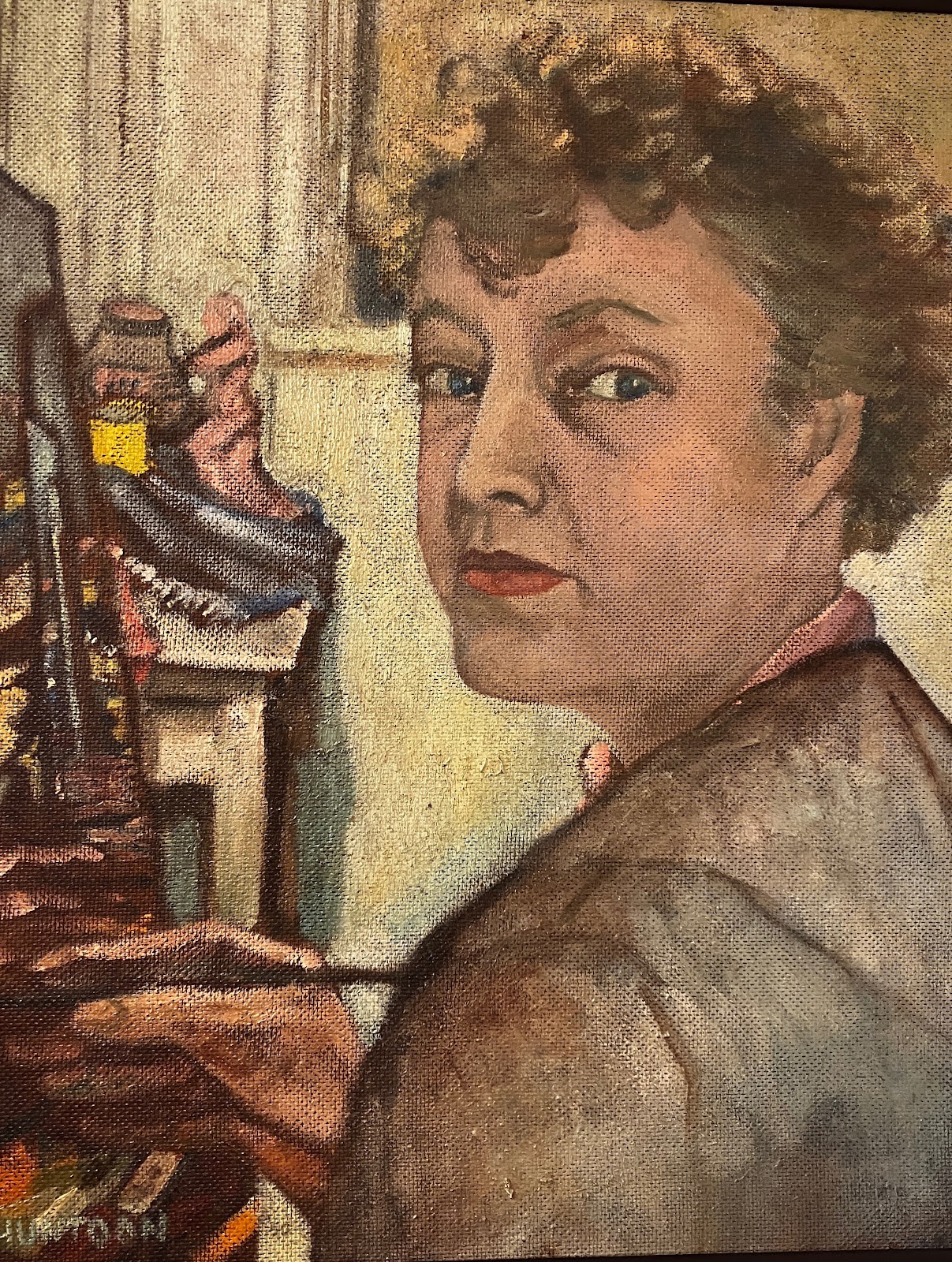
Mary Huntoon Self-Portrait
Topeka and Shawnee County Public Library

By Michael Hooper

Mary Huntoon (1896-1970) was an exceptional artist who worked in New York and Paris before practicing art therapy in Kansas.

Huntoon grew up in Topeka, where she was a pioneer in the field of art therapy, working for Dr. Karl Menninger at the Menninger Clinic.

Huntoon trained at The Art Students League of New York and worked in Paris for five years. Huntoon’s own artistic style might be called expressive realism. Her graceful lines are similar to the style of Suzanne Valadon (1865-1938), a Parisian artist who worked in Montmartre at the turn of the 20th Century. 


Painting by Mary Huntoon
Topeka library

Huntoon’s great-grandfather Joel Huntoon was a Topeka pioneer who mapped out the Topeka street plan, including Huntoon Avenue.


Mary Huntoon was born in 1896 and raised on a cattle ranch until age 8 when her mother moved to Topeka and remarried. They lived in the old stone Huntoon home at 219 Huntoon Ave. 


Huntoon was editor of The World newspaper at Topeka High School, and contributed art to the student yearbook. With a desire to become an artist, she attended Washburn University. George M. Stone, a highly paid portrait painter, taught her landscape and portrait painting.


After graduating from Washburn in 1920 Huntoon married Charles Hoyt, a veteran who served in France in World War I. He was a journalist and writer. The two moved to New York City where he worked as a writer and editor for the New York Evening Sun and the New York World-Telegram.


Mary Huntoon attended the New York Art Students League for six years, alongside Ben Shahn and Mark Rothko. Her anatomy instructor George Bridgeman taught students to develop discipline and stamina to withstand criticism. Her metal plate media instructor was Joseph Pennell, a leading American etcher and illustrator. Huntoon quickly learned the skills etching and printing and was a good draftsman.


Mary Huntoon attended a lecture class by Robert Henri, a beloved and charming teacher, who championed women students, as well as the American experience as art. He encouraged artists to paint as they wished, and to portray their subject as they themselves felt about it, not simply a representation of its outward appearance. She emulated his style to a certain extent. His painting, the Beach Hat in 1940, is similar in style to portraits that Huntoon painted in her later years. 


In 1926, Huntoon went to Paris. She had only intended to stay for a few weeks, but ended up staying five years.


In Paris, she fell into a crowd of Montparnassians who gathered at Le Dôme Café at 108 Boulevard du Montparnasse. Le Dôme, which is still operating today, was an intellectual gathering place for artists and writers, particularly the American literary colony, during the interwar period. Letters archived at the Spencer Research Library at the University of Kansas show Huntoon had a wide ranging group of friends at Le Dôme. Her friend Edith “Nellie” Thain writes that their mutual friend “Abbie continues to drink too much, and judging from what I saw the other day does not eat enough.” 


Other friends include Mr. Hogg, Oscar Gray, Moreton Hoyt, Ludwig and Wally. “Mr. Hogg is back.…I always suspected him of having a weather eye out for you. Ludwig thinks this is disgusting,” wrote Edith “Nellie” Thain in Nov. 4, 1930, letter to Huntoon. 


In 1929, Huntoon wrote that Paris has greater sympathy for artists than does any part of the United States. "Paris appreciates and encourages the artist. His struggle for material is less, and is often given a chance to work out his own destiny without some of the handicaps facing him in the United States," she wrote. Her sixth floor apartment and studio in the Latin Quarter became a focal point for much activity, according to research by Mary Lou Casado, author of Mary Huntoon: In Search of the Meaning and Duty of Modern Art, a book Casado submitted to KU for her bachelor of arts with honors in April 1980, now located in the Topeka Room at the Topeka and Shawnee County Public Library.


In 1926, Huntoon demonstrated her etching technique to Stanley William Hayter, who gave his first print, Bottles to her. Both studied burin print making under Joseph Hecht in Paris. In 1927, Hayter created the Atlier 17 studio in Paris for etching and engraving. Pablo Picasso, Joan Miró and Wassily Kandinsky visited his studio to make prints. 


Huntoon stayed in Paris alone, leaving Charles Hoyt, her husband back in New York to carry on his own work, Casado wrote. But in 1927 he joined her for a nine-month stay on the island of Corsica. Mary Huntoon had her first show at the Galerie Sacre du Printemps, Paris, in 1928. Seymour De Ricci said her paintings had robust brush work, and original, colorful, broad flat tints. Her etchings were refreshingly original. 


Charles Hoyt carried out a hoax to test attitudes using the synonym George O’Keefe, writing a letter in the Paris edition of the New York Times, referring to Mary Huntoon, insisting no woman has distinguished herself in 5000 years and it is a little late to begin hope. Readers immediately responded with disgust for the misogynist, defending Mary Huntoon, and other women artists, said Sherry Best, art collection curator at the Alice C. Sabatini Gallery at the Topeka and Shawnee County Public Library.


Unfortunately, during the height of her success in Paris, her beloved husband, Charles Hoyt died in late 1928. His health was never very good since being gassed in World War I, and he died struggling with tuberculosis. Nevertheless, she stayed in Paris for another year after his death.
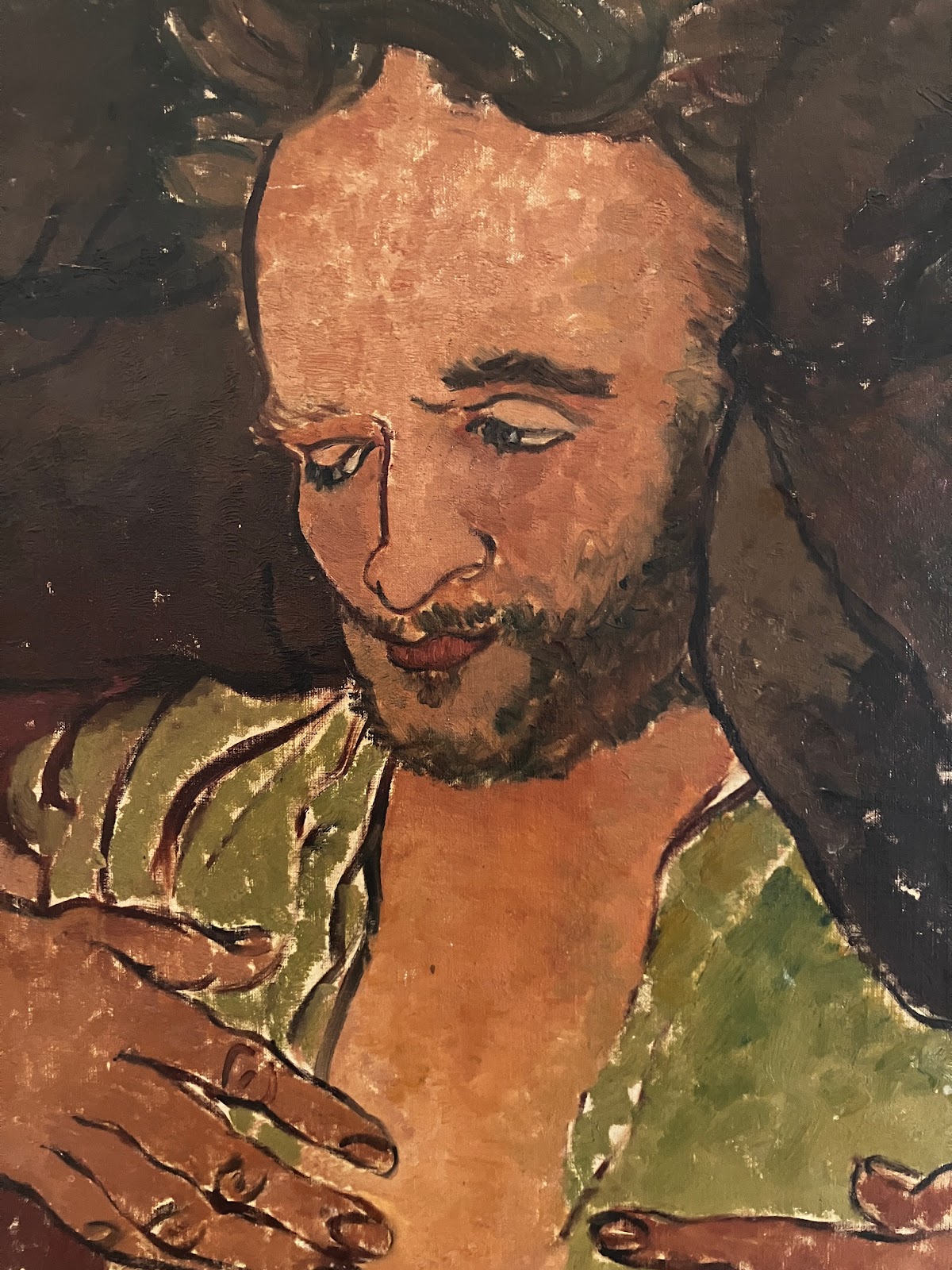

Cradle of Thought by Mary Huntoon. Portrait appears to be her first husband Charles Hoyt. Painting courtesy of the author


Casado’s book says it’s unclear why Huntoon left Paris, but she was perhaps like other ex-patriots who discovered that while they loved Europe, they were deeply American. I can relate. When I lived in Greece and Spain in 1990, I gained a lifelong fascination for Europe, but I felt a longing for the Great Plains, where I eventually returned to work as a journalist, marry and raise children.


Yet her time in Europe sustained her for the rest of her life. Huntoon wrote, “The net result of living in old Paris and Europe is that I feel more than ever the newer civilization of the states and more specifically the pioneer states and my dream has changed.” 


In the 1930s, she taught art at Washburn University, including etching, painting and art history. In 1932 she married Lester Hull, who worked in the art department at Washburn. After they married, they studied and painted in Germany, Czechoslovakia and Italy. When they returned, she continued to immerse herself in the art world. Lester Hull had health problems and required constant care and attention. This was too much of a burden for her and eventually they divorced and he returned to Chicago to be near his sister. He died in 1948. 


In 1934 she worked for the Public Works of Art project, later the Federal Art Project, created by the Civil Works Administration under President Franklin Roosevelt. She did several works of art under the FAP until 1939.


Mr. Jones by Mary Huntoon, Topeka library


In the late 1930s she was also working as an art therapist at the Menninger Clinic. Dr. Will, Dr. Karl and their father Dr. C.F. Menninger founded the Menninger Clinic in 1925. Using Freudian concepts, they believed that trauma or conflict hiding in the subconscious is discernible and curable through psychoanalysis and psychotherapy. Therapeutic activities might include woodworking, garden therapy, music therapy and art therapy.


“It was never just busywork,” said Dr. Bob Conroy, a retired Menninger psychiatrist. “Dr. Will wanted activities to help patients deal with their pathology.”


Everyone at the Menninger Clinic was involved in therapy, whether it was the nurses, the doctors, the janitors or the cafeteria workers who all offered kindness and friendliness to the troubled patients. 


Principal mediums in Huntoon’s art department were oil painting, clay modeling and engraving. Huntoon said Ruth Faison Shaw used finger painting at Menninger’s Southard School for children.


Rosemary Menninger, daughter of Dr. Karl Menninger, met Ruth Shaw in the 1950s when Rosemary was probably around kindergarten age. Ruth was a friend of Rosemary’s mother.


“My Dad told me something when I was working in garden therapy,” Rosemary recalled. “He said, ‘don’t fall into the trap of analyzing the person by trying to interpret what they are planting. Instead, focus on the fact that they’re working on something and bringing it to fruition. Is it the idea that they are creating and cultivating something that is more important.”


Writing in the Bulletin of the Menninger Clinic in November 1949, Mary Huntoon quoted Freud as saying the creative process is a way to keep destructive tendencies at bay. Picasso claims that a painting is worthy of the name of art when it takes charge of the painter at a certain stage, in other words, when the creative process is aroused in a person, it is a liberating agent for unconscious material of the mind. 


While working at the Winter VA Hospital in the 1940s, under the direction of Dr. Karl Menninger, she found that art therapy could fall into four categories, including fantasy or wish fulfillment. Sometimes the patient expresses fantasies which are a prophecy of what is to come. For example, when a bedridden patient came to the studio in a wheelchair, he painted himself outdoors in a daisy field.


The second function of art therapy is dexterity, this helps the individual gain strength and security at developing a skill. The third function of art therapy is relief of anxiety. By drawing or painting, the patient puts down in a graphic way the aggressive and traumatic feelings that are deep in his subconscious. This is a form of art synthesis.


The fourth function is externalization and mastery of subjective thoughts and emotions. A patient who was diagnosed with psychoneurosis, anxiety type, with an obsession for masturbation, was too self-conscious to paint the first day, but the second day began with encouragement to try to put some paint on canvas just to get a feel for it, Huntoon wrote. Over time, he began trying to paint still lifes, including a trash can. This marked a turning point; painting became fun. He painted several credible paintings during a two-week leave. Through his paintings, this patient turned his emotional expressions into socially acceptable forms, thus gaining some mastery over his emotions, so that he was no longer at their mercy, Huntoon wrote.


“Another very important function is the interaction with the art therapist,” Conroy said. “My good friend, art therapist Bob Ault (who worked at Menninger) encouraged the patient to draw or paint, but that was only the beginning. He also was part of the therapeutic team and participated in the patient evaluation. He was able to use the conversation and comments the patient made to help with the treatment. Thus, there was a double benefit. The first was the art work itself which tapped the unconscious and hidden dynamics. The second was a psychotherapy process as the patient interacted with the art therapist. The process of creating the art often took away the fear that some patients had of interacting with a traditional therapist. Bob Ault and the therapy team worked together with many patients and the therapy was greatly enhanced by this joint effort.”


Huntoon worked in art therapy for about three years at the Menninger Clinic and 12 years at the VA, serving thousands of patients, most with no formal art training. She exhibited her students’ works, believing recognition of their talents was therapeutic, Casado wrote.


Huntoon was a pioneer in art therapy because of her contributions to the emerging field in the 1930s-1950s. In the 1970s and 1980s, authors like Arthur Robbins more clearly defined art therapy as a profession. His book The Artist as Therapist is a popular book in this field. In a discussion on colors, Carl Jung says green is for sensation, yellow for intuition, red for feeling and blue for thinking.


Mary Huntoon is largely unknown, but her work is popular in Kansas and the Midwest, and can be found in the Spencer Museum at the University of Kansas, the Topeka and Shawnee County Public Library, and the Mulvane Museum and the Newark Museum of Art. 


Sherry Best, art curator for the Alice Sabatini Gallery at the Topeka and Shawnee County Public Library, said Friends of the Topeka and Shawnee County Public Library has been selling duplicate Huntoon prints through Soulis Auctions, Lone Jack, Mo.


When Mary Huntoon died in 1970, her third husband donated her remaining artworks in her studio to the Topeka and Shawnee County Public Library, said Best. Two of her paintings now hang in the library’s reading room; other paintings and prints are stored in the basement.


Best recently gave a tour of the library’s Huntoon collection to me and artist Luke Van Sickle. Her work is contemplative, somber, harmonic, philosophical and sublime. She is one of the best portrait painters in Topeka's history. She was an excellent educator and effective art therapist. Best said her clients usually got better after working with her. Huntoon stayed in Topeka, partly because of the opportunity to work with Dr. Karl Menninger. Had she stayed in New York or Paris, she probably would be more famous today, Best said.


Portrait by Mary Huntoon


Fredda Burwell, print by Mary Huntoon

Painting by Mary Huntoon


Tuesday, April 4, 2023

CapFed Stock Falls To Historic Low


By Michael Hooper

Stock in Capitol Federal Financial (CFFN) has fallen to a 20-year low following the failure of Silicon Valley Bank.

CapFed stock already was near a historic low before the banking crisis hit March 9, but plunged another 20% to $6.50 per share.

Capitol Federal stock came out at $10 per share in its initial public offering in 1999. The stock ran up in the early days after the IPO hitting a high of around $45-$50 per share. The bank did a stock split offering 2.2637 shares for every single share in Dec. 22, 2010. The split adjusted low for the stock occurred around Feb. 25, 2000, when the stock was around $4 per share.

The stock traded around $11 to $15 per share for many years, but has fallen 50% from there.

The banking crisis, led by Silicon Valley Bank, has hurt nearly all stocks in the banking sector. Banks' long-term bonds have lost value due to the Federal Reserve Bank raising interest rates over 400 basis points in a year. Capitol Federal Financial has $132 million in unrealized losses in its $1.7 billion bond portfolio. The losses don't necessarily have to be realized if the bank holds the bonds to maturity.

But there are other reasons why Capitol Federal Financial stock is suffering.

CapFed earnings have been trending down in recent quarters, with $0.12 per share in first quarter 2023, a penny short of estimates.

Capitol Federal has limited itself in growth; the bank has resisted growing over a $10 billion bank. When a bank is larger than $10 billion in assets, the institution faces additional supervision and regulatory costs.

After the IPO in 1999, CapFed bank was flush with cash, with capital representing 17% of total assets. The bank distributed that excess cash through dividends and special dividends over the years. Some of that cash also was used for buybacks of stock. The bank has paid out more in dividends than it earns every year over the last decade. Last year, for example, CapFed paid out $0.82 in regular and special dividends but only made $0.58 in earnings per share.

The bank's capital has fallen to $1.05 billion or 10.6% of the total assets.

Capitol Federal is fond of using a leverage strategy to borrow money from Federal Home Loan Bank of Topeka and reinvesting the money at the Federal Reserve Bank of Kansas City. Capitol Federal had borrowed up to $2.6 billion from Federal Home Loan Bank of Topeka and put the money with the Federal Reserve Bank of Kansas City. The company made $763,000 on this arbitrage deal in the most recent quarter. However, because this leverage strategy has fallen in profitability, the company has paid down a portion of the debt owed to Federal Home Loan Bank of Topeka.

The largest owner of Capitol Federal stock is Black Rock with 20.3 million shares or 14.8% of the company. T Rowe Price recently sold 12.8 million shares, but still owned 248,069 shares in February. Meanwhile, Dimensional Fund Advisors, led by David Booth, a KU graduate, has acquired 7.8 million shares or about 5.2% of outstanding shares of Capitol Federal stock. 

About 86% of Capitol Federal’s loans are residential home loans. This is a good investment. The Kansas economy is doing fairly well. Unemployment is low, and jobs are plentiful. During the mortgage crisis of 2008 and 2009, many banks suffered losses, but Capitol Federal's loan portfolio survived that crisis pretty well because of the high credit quality of its loan base.

The book value of Capitol Federal stock is around $7.75 per share, so the stock is actually trading below book value at current prices. This is not uncommon in the banking sector, especially during a financial crisis. However, most bank stocks typically trade above book value, which is assets minus liabilities.

Capitol Federal stock has historically been viewed as a good dividend paying stock. However, when the stock price falls below the amount paid in dividends, the shareholder ends up losing value. With falling earnings, it makes me wonder about the future of special dividends. The board of directors shouldn't deplete capital in order to pay dividends.

Last year's total dividend payout of 82 cents per share would equate to a 12.35% yield at the current price. The yield for the regular dividend is 5.12%.

Capitol Federal will weather this latest banking crisis, but the size of the company probably will not grow over $10 billion. As a result, I don't see much upside in the stock. However, if the stock gets super cheap, say around $4.00 per share, you may see deep value investors invest in the stock.

Author Michael Hooper does not own any shares in Capitol Federal Financial (CFFN). 

David Tangeman, an accountant, contributed to this article.


Friday, March 3, 2023

Union Pacific Needs New Leadership


By Michael Hooper

Union Pacific (NYSE: UNP) needs new leadership. Union Pacific recently announced it plans to replace CEO Lance Fritz. The announcement on Sunday, Feb. 26, 2023, follows a Wall Street Journal report citing a hedge fund's call for his replacement.

Soraban Capital Partners says that under Fritz, UNP employees are disgruntled. Among all S&P 500 companies, UNP is rated by employees as the worst place to work, and has the lowest employee CEO approval rating. The company is not delivering on its commitment to customers, and the Surface Transportation Board has singled out UNP as providing the worst service among Class 1 railroads.

Union Pacific has around 32,000 employees, including about 800 employees in Kansas where it maintains about 2,199 miles of track.

One of the disturbing trends of Union Pacific is using debt to re-purchase shares and pay dividends while ignoring the needs of customers and employees.

Union Pacific easily makes enough money to cover its dividend, but has been re-purchasing shares at a significant rate, resulting in the need to borrow money.

Long-term debt at Union Pacific has grown from $15.6 billion in September 2016 to $33.3 billion on Dec. 31, 2022, essentially doubling the debt during that time. But -- and this is huge -- total carloads/intermodal traffic actually declined from 9 million in 2015 to 8 million in 2022.

Yet Union Pacific continues to re-purchase shares and has announced a new share repurchase program with authorization to re-purchase up to 100 million common shares through March 31, 2025. Under this new program the company could reduce share count by a whopping 16%. 

However, share repurchases essentially benefit only shareholders of the stock, i.e. Wall Street. This form of using capital does not benefit customers, it does not benefit employees unless they own the stock, and it also doesn’t benefit the rail network. A better way to grow a company is to build organic growth in the business, using capital in strategic places that will benefit customers and the network. There have been times in the past few years that Union Pacific has turned away business because it did not have the employees or equipment in order to serve these customers. 

In April 2022, Pilot Flying J CEO Shameek Konar said Union Pacific informed Flying J to reduce diesel rail shipments by 26%, then in subsequent conversations with the railroad, Union Pacific asked them to reduce rail shipments by another 50% or face embargoes. Essentially Union Pacific was turning away business because it could not handle it. 

Railroads cut employees too deep while lengthening their trains from 1 mile to 2 miles. So you have more cars on the track with fewer people looking after them. As a result you get situations like what happened in Ohio with Norfolk Southern, a disaster that will have health and environmental consequences for years to come.

Borrowing money in order to buy back shares is going to cost more money because interest rates have been rising over the past year. This strategy will be crippling to the business if we have a recession and  earnings decline. You can’t continually raise prices in order to grow earnings. Shippers will look elsewhere for moving their freight. 

I hope the next CEO improves the balance sheet and puts capital into growth markets, and looks for ways to increase safety, morale, and ensure the franchise grows in book value and market value at the same time. Earnings will grow as a result of all these other measures over time. Don’t grow value by buying back shares.

Union Pacific released a press release on Feb. 26, saying under Fritz's leadership, the company has achieved a 52% increase in net income, a 27% increase in operating income and a 3.7 point increase in return on invested capital. Fritz guided the company to achieve this financial growth despite the volatile operating environment spurred by the COVID-19 pandemic, global supply chain disruption, labor negotiations and service and labor challenges, while instilling an inclusive and accountable organization with an industry-leading sustainability program.

“The Board is grateful to Lance for his unwavering leadership, dedication and oversight in driving our company forward over the last eight years as CEO. Lance created an environment that has allowed Union Pacific to make a measurable impact with our customers, communities and employees alike,” said Michael McCarthy, Lead Independent Director of the Board. “He has capably led our company during a time of significant challenge and change, positioning Union Pacific to deliver long-term sustainable value for shareholders and customers. We are immensely grateful to have Lance’s continuing leadership and support and know he will ensure a smooth transition.”

“It is my honor and privilege to serve this great company. I am proud of our team and all we have built together,” said Fritz, Union Pacific Chairman, President and Chief Executive Officer. “I’ve always said that our fundamentals for long-term success are powered by our people – our best-in-class employees and the passion they have for our customers and communities. Union Pacific has embarked on a transformative journey that will result in stronger, more consistent service for our customers, with enhanced earnings growth and value creation for our shareholders. Union Pacific has been my home for 22 years and I am confident that now is the right time for Union Pacific’s next leader to take the helm. I look forward to working with the Board as we identify our next CEO to lead the Company into the future.”

Michael Hooper, editor of Thoughtful Investor, owns shares in Union Pacific (UNP).


Tuesday, February 21, 2023

100 Billion Souls

The Universe by Michael Hooper

There are 100 billion souls on the other side
They live in the ethereal afterlife
Some live in my memory
Some in my heart

Like a gigantic swath of solar power
The dead rise up, giving life to history 
in books and manuscripts 
these noisy ghosts try to change the direction of humanity

The artist is hard at work, toiling away in poverty and shame 
Injustice everywhere, yet he carries on with a passion for his art, 
he knows there is something exquisitely divine 
in the wonderment of sands washed upon the shore.

Trash comes up from the ocean and spits out plastic on shore, the Earth is trying to heal itself.

Pain and anguish are unending. He prays without ceasing, he hopes for a moment of relief.

The artist knows the sublime beauty of the sounds of the sea at night 
He looks at the dazzling lights in the dark sky and
contemplates the knowledge that there are more stars in the universe than sands on the Earth.

He ponders the vastness of the universe and what is beyond.

The artist has neglected his lover; she is feeling abandoned. 
Where is my husband? she cries. Why is he not here beside me in bed?
why does he wander the streets at night like a vampire? 
When is his wanderings going to end?

The artist believes he will never feel satisfaction, contentment, or peace, because the bubbling inferno of his soul constantly is striving for the heavens

Searching for harmony, a glow in wonderment, 
100 billion souls haunt him tonight. What are they doing in this afterlife?
Where are they going? What are they thinking about? 
Do my parents pray for me? This soul lying here, on this empty beach at midnight.

He says, "Alone, alone, alone, I wander, I strive, I struggle to create something sublime."  

The artist walks the ruins of Rome, graveyards of statues, chasing mystic reveries and ghosts among the 100 billion in the afterlife.  He finds these beautiful ecstasies a melancholy sweetness.

And in the morning he feels despair raging with sadness, pain and emptiness.

When she finds him awake, she says, don’t spend another minute, chasing the dead, your friends are among the living, these cemeteries are just in your head.

Death is the ultimate conquerer of life, but don’t stop fighting now, 
you have a long life ahead of you, 
death may win in the end, but today is for the living, 
go now, and climb your mountains, swim in the seas, 

Make love to me
engage with your friends, 
there is joy, and peace for the man of love 

Buildings crumble, ships decay, 
and people die, but love lasts forever


-Michael Hooper, Feb 21, 2023

Thursday, February 16, 2023

Artie Ravitz Remembers John Lewis


John Lewis, young & old
Credit Wikimedia Commons

Editor's note: In celebration of Black History Month, I want to remember the legendary civil rights activist John Lewis who was born on Feb. 21, 1940, and died July 17, 2020. My friend Artie Ravitz met Lewis while he was a student at Penn State University. Ravitz witnessed extraordinary events while in the company of John Lewis. I met Ravitz while staying in Esperanza, Vieques, PR in January. Ravitz, 82, is a former toy manufacturer, who now devotes himself to writing about various topics including civil rights and crime. Here is his story: 

By Artie Ravitz

         I had seen the horrible beating of 300 citizens of Selma Alabama, and    civil rights workers on the 6 pm TV news, on March 7, 1965, while attending a NY toy show. I was so upset that I told my wife Susie that I was leaving the following morning for the next Selma march. She stopped me by telling me that there would be no march tomorrow. Instead, I should call the SNCC (Student Nonviolent Coordinating Committee) office in the morning, to get word about the date for the next march. She was right. When I called the SNCC office,  Constancia "Dinky" Romilly, the Northern Coordinator, promised that she would call me when SNCC leaders had spoken with government officials and had settled on a new date for the next march. 

         The march was the culmination of years of voting efforts, by SNCC and others, to conduct voting classes throughout Alabama and Mississippi. SNCC was a small civil rights group of students who led the student sit-ins in states throughout the South and currently were concentrating their efforts to teach voting in two of the toughest states governments whose officials tried to keep Black voter registration down to an absolute minimum.

          In 1965, all SNCC efforts were focusing on one thing, getting the right to vote for all persons of color in the South. So, it was a big deal for millions of Black citizens of the USA, to see state officers and Alabama State Troopers, charging into the marchers, on horses and on foot, with clubs, assaulting and beating the marchers until they fell back and returned over the bridge to Selma. 

        I had been sending “care packages” to the SNCC voting rights workers who were only getting $9.00 per week for bare necessities of life, when Dinky called me back a week later. She told me that the new march would be the 20th of March, but that I should come directly to the SNCC office a day before, in Atlanta, and join the SNCC officers on their drive to Selma. I agreed to her offer. Dinky and I had been speaking for the past few years. Eight days later, Lee Harris and I drove to Newark Airport, jumped onto a plane to Atlanta, and took a taxi to the SNCC office in Atlanta. 

         We arrived there early afternoon and after greetings, we are told to wait in the lunch room and help ourselves to sandwiches until Dinky would tell us when we were leaving for Selma. Just before 4 pm, Dinky came in, telling us that everyone was waiting downstairs for us, ready to leave. Lee and I went down stairs and joined them. Lee got into an old blue Chevy and I got into the white '52 station wagon. Both cars left for Selma at the same time.  

         The Atlanta traffic did not allow us to stay together and soon we were weaving in and out of traffic, heading northwest. At one stop light, there was a cop looking into the car. That was when the short guy sitting next to my right, pushed my head down. A few blocks later, we spotted a police car nearby when the short guy sitting near to me again pushed my head down. 

         After the second time, I decided to ask him why he was pushing my head down. He told me that he did not want the cops to see me in a car full of Black guys. I found out later that the short guy’s name was John Lewis and he was the current chairman of SNCC. After we passed the police car, he explained to me that he did not mind being arrested when he was on the Selma March; but, he did not want to be arrested by some racist cop stuck out here in the “boonies”, where he could be forced to miss the big Selma to Montgomery march, and have to wait a few days until he got bailed out. 

          Three hours later, after having my head pushed down a few more times, we arrived at the small town of Tuskegee, Alabama, and a few minutes later, the entrance to Tuskegee College, in northern Alabama. The driver stopped directly in front of the dining room. When we entered, the SNCC kids were greeted as home town heroes. I learned later that many of the students here were SNCC summer voting rights workers. John told me that we stopped here because it was one of the few places where we could safely eat as a mixed group. After an hour discussion, a warm meal, and warm goodbyes from everyone, we jumped back into the car and headed southwest toward Selma.

          When we got Selma, we again stopped at an integrated diner for a light snack. After we were done, none of the SNCC kids would get up to leave.  Each asked the other to go outside to see if their car was still there. They were giggling and kidding about delaying our departure, but I didn’t know why. But after one guy finally, got up and left, we all followed him out. I was told later that the joke was about all of them being afraid to go out, since 10 days earlier Reverend Jim Reeb, a white minister, was dragged out of the restaurant, beaten by a white mob and dying two days later. Humor was their way of living with the grief of his murder.

          The March to Montgomery started at 10 a.m. the following day. John Lewis was up front, of course, with Dr. Martin Luther King, Jr. and other dignitaries and I was half way back walking with, talking to and listening to Joan Baez sing a few songs, and to Dick Gregory tell us a few jokes. 

         John Lewis held on to the chairmanship of SNCC for a few more years and participated in hundreds of demonstrations and arrested 40 more times until other more militant members took over the reigns of SNCC because the SNCC leadership got frustrated and in 1967, the organization's leadership was taken over by H. Rap Brown and Stokley Carmichael. The new leadership took a more militant path calling for “Black power” for Afro-Americans. They had many followers. The Black Panthers movement grew out of their efforts.

         The big mistake the new SNCC leadership made was they began flirting with the Palestinian terrorist group who persuaded SNCC leadership to publish photos showing Jews shooting Palestinians, who had their hands up. But, as soon as the ADL ( Anti Defamation League ) learned of SNCC’s mislabeling of the photos, the ADL published the same photos, which had been taken 30 years earlier, but which were taken of German troops aiming at Jews with their hards up in the Warsaw Ghetto taken in 1944. This major scandal caused SNCC to loose 75% of their funding and forced them to close their doors, for good, a year later.

         When Lewis was 17 years old, he went Montgomery to speak with Dr Martin Luther King for help him in getting into all white Troy State College, but although King offered to help, his family was against a law suit, so he dropped the idea. But, from that day on, Dr. King continued call Lewis, “the Boy from Troy.” After he attended a workshop of a follower of a Gandhi philosopher on non-violence, he joined CORE to participate in many sit-ins at Lunch counters, movie theaters, and businesses. He was elected to the board of the (Southern Christian Leadership Conference) SCLC in 1962, and in 1963, he organized and took over the  leadership of SNCC.

     But, John Lewis did not stop there. In 1963, he helped organize and spoke at the historic March on Washington where Dr. King gave his famous, “I have a Dream” speech for jobs and for an end of racial discrimination. And on Sunday, March 7, 1965, John Lewis led 600 members of Selma voting group over the, now famous, Edmund Pettus Bridge, only to be beaten back by brutal Alabama State Troopers with clubs injuring a hundred marchers. This brutal attack was seen in hundreds newspapers all over the world and became known as “Bloody Sunday.” 

         After leaving SNCC, Lewis took a job with the Field Foundation in NY City organizing voter registration campaigns all over the segregated South. He was successful in adding 4 million minority voters to the voting rolls, forever changing the voting landscape. In 1981 he was elected to the Atlanta City Council and in 1986, to the US Congress. He authored many bills favoring civil rights, lobbied for the poor, disadvantaged and was re-elected to Congress 16 times.  

         When Susie told me that John Lewis was speaking at Moravian College, we immediately decided to go and hear his talk. I called his office the following morning and spoke with Mike, his legislative assistant, telling him that I would like to speak with him for a few minutes.  Mike agreed to give John my message.

         The following Thursday, Suzie and I got there early enough to get two front seats in the auditorium. We listened to John’s speech about how he learned to speak by giving speeches to the chickens in his dad’s chicken coop and what his plans were for the following year in Congress. The auditorium was packed with his admirers and he got long lasting applause after his talk.  

         We went up and gave each other a hug and asked about each other’s health. We then spoke about the ride to Selma, and when he was pushing my head down so that the cops would not see me in the SNCC car. We parted again with hugging each other when saying goodbye. 

         It was quite a thrill for me to see him again and remember many of the things John went through to protect the rights of his fellow man. It was a great end to an early decade and chapter of my life; but for John Lewis, the fight goes on. John Lewis died on July 17th, 2020, of pancreatic cancer at age of 80.  He left our world, as one of the top Civil Rights heroes of the 21st Century.


Michael Hooper & Artie Ravitz eat breakfast together in Vieques, PR


Monday, December 5, 2022

FTX Bankruptcy Should Be Wake-Up Call For Congress & Investors


Sam Bankman-Fried

By Michael Hooper

The failure of Sam Bankman-Fried's company FTX has far reaching implications. Even though it operated in the Bahamas, many investors, including the state pension fund of Kansas, are from the United States.

FTX, an international cryptocurrency exchange, and its subsidiaries filed for bankruptcy on November 11. The company at one time was valued at $32 billion, but now more than a million customers fear their assets are gone.

Bankman-Fried told the New York Times Deal Book conference in Manhattan that the failure of his company was due to huge management failures, and sloppy accounting. But others like CoinDesk say the failure was due to the company using customer funds for the hedge fund Alemeda Research, losing much of the money on bad trades with too much leverage.

The Missouri public pension fund invested $1 million into FTX via Blockrock, a money manager. The Kansas pension fund KPERs invested $187,400 into FTX.

Sam Bankman-Fried had specifically promised customers it would never lend out or otherwise use the crypto they entrusted to the exchange.

Another red flag with FTX is the lack of a Board of Directors. Operating in the Bahamas, it appears there was little oversight. A board of directors can provide accountability and oversight while conducting annual audits to make sure the books are clean.

How Sequoia Capital, a reputable investment firm, gave $213 million to FTX as an investment is beyond me. Promoters billed Sam Bankman-Fried as a wonder kid who grew up with highly educated parents in Silicon Valley. He believes in effective altruism; earning as much as possible so you can donate it to charity. But the reality is Sam Bankman-Fried is a con man. He was holding up a house of cards with his mouth.

David Morris at crypto website, CoinDesk, says many news outlets have perniciously described what happened to FTX as a bank run or a run on deposits. But the exchange was not a bank. The big problem is that FTX assets were intimately linked to the trading firm Alameda Research where it seems they were simply gambled away, Morris wrote.

FTX was using leverage to make trades. Leverage can be very dangerous. Extreme levels of leverage brought down some of the biggest financial houses in history, including Lehman Brothers and Bear Stearns.

The FTX failure should be a wakeup call to Congress, which has failed to come up with a formal crypto regulatory policy, even though Bitcoin has been around since 2009.

When public pension funds in Kansas and Missouri put money into crypto companies like FTX without any real scrutiny, the public is likely to get burned. I know I could have managed that money much better than Sam Bankman-Fried. I got into crypto in 2017 and sold out in 2018 and moved the proceeds into my vacation fund. I also invested some of the proceeds into gold and Berkshire Hathaway. Both choices turned out well. I still own a little crypto but never saw the crypto market as stable enough for large amounts of assets.

I wouldn't recommend betting your retirement on crypto assets. It's better to have your wealth diversified across stocks, bonds and real estate.