Friday, October 18, 2024

Investor Opportunity: Casey's General Stores Grows in Texas


By Michael Hooper

I recently added to my position in Casey's General Stores (CASY) even though the stock is near historic highs.

I learned, over 30 years of investing, to sell the losers and buy more of the winners. CASY stock has been a winner for many years. I started buying the stock in spring 2020 during the Covid stock market crash. 

Casey's stock is up 42% year-to-date and up 133% over the past five years. The stock closed Friday, Oct. 18, 2024, at $390.15 per share.

Recently I've been watching the company strategically plan and grow in Texas.

Casey’s is acquiring Fikes Wholesale with 198 retail stores and a dealer network. Most of those stores, 148, are in Texas. The $1.15 billion acquisition will close by year’s end. 

A year ago, Casey’s had made its first move into Texas with the purchase of 22 Lone Star Food Stores. The Fike’s deal also includes 50 stores in Alabama, Mississippi and Florida, bringing to 20 the states with Casey's stores after the acquisition is complete.

“To say we would have 1,000 stores in Texas someday is not a huge stretch,” said Darren Rebelez, president, and CEO, and chairman of the board of Casey’s. He and other managers spoke about the company’s operations and outlook during Analysts Day Oct. 15 in Ankeny, Iowa, headquarters for Casey’s. I listened to their presentation for an hour and 45 minutes online. The CEO and the executive team seem very knowledgable about opportunities to grow the business and improve margins.


Rebelez said management like the Fike's deal because of its large format stores, with 4800 square feet, with kitchens; and they're in great geographies, in the target market of Texas and the growing Alabama/Florida panhandle.


Casey's has more than 2600 convenience stores in the Midwest and is third-largest convenience store retailer and the fifth-largest pizza chain in the United States.


Casey’s stock is up $100 per share since I wrote about the company in this piece in January recommending investors buy the stock.


After such a runup, I still believe investors should own the stock, however they are buying today at a higher than normal price/earnings ratio. The P/E ratio on the stock has risen from 21 to 28 this year. The historical average P/E ratio for this stock is 22, according to ycharts.


As a result of the big run up, I believe the stock is more of a hold than a buy, however, I have recently purchased more shares at $365 and $387 per share. 


I believe the stock is in the trading range from $362 per share to $392 per share. Take a look at this chart:


CASY chart for 15 days of trading


See how the stock fell to about $362 per share at the far left and then started climbing up and hit $375 and then went down below $370, dipped into the $360s and then ran up to $396 and suddenly dropped substantially to the $377, when I bought more shares.  I figure the stock will go back to $392 again and perhaps $400 per share eventually.


I recommend buying and holding this stock for 3 to 5 years to get the most benefit out of the current strategy.


Casey’s strategy is buying stores at 6 to 9 times earnings, renovating with new kitchen for fresh baked goods like their popular pizzas and donuts. This is a high margin business that makes the convenient store more profitable.


"There are 150,000 convenience stores in America. Food is our differentiator," Rebelez said.


Indeed, about 2/3 of Casey’s gross profit, stems from in-store sales, customers buy a lot of pizza and beer. Cigarette sales are on the decline, but that doesn't hurt Casey's because of its diverse merchandise offerings, including its own company label snacks and water.


Rebelez said employees recently rebuilt the sandwich lineup with its new Spicy Crispy Chicken Sandwich, Crispy Chicken Sandwich and Quarter Pound Angus Beef Burger. These sandwiches are in the warmers, freshly prepared every day, ready to eat. Sales for sandwiches have increased substantially as some customers choose a whole meal rather than just a snack.


Casey’s has been averaging about $0.35-$0.40 per gallon margin on the sale of gasoline. That brings in millions every day.


The company's growth model is about 50 percent acquisition and 50 percent new builds, but this changes depending on economic conditions. Cost of construction has gone up considerably in recent years.


"M&A or organic growth, we can do it either way," Rebelez said.


Casey's serves a lot of small towns but also has quite of few stores in larger cities like Topeka, which has five Casey's locations. A sixth location is going into Campus Center at 17th Street and Washburn Ave., across the street from Washburn University.


In 2019, Red Mountain Group, Inc. of Santa Ana, Calif., purchased Campus Center shopping center in Topeka located at 1634 SW Washburn Avenue. In spring, the group started renovating the retail space while preparing the land at the corner for a new building for Casey's General Stores. That store will attract a lot of customers because of its prime location.

Stocks like Casey's trade at a high multiple for a reason. I think the reason is a proven plan of growth.

Casey's strategy: 

--delivering Quintle EBITA growth of 8-10% per year.

--Accelerate the food business

--Grow the number of units

--Enhance operational efficiency.

Casey's has consistently achieved 8+% Ebita growth for over 10 years, Rebelez said. Not many retailers have done this. O'Reilly Auto Parts has done this.

I believe management have figured out the growth strategy after years of experience. CASY stock is near all time highs but I want more shares. If there is a pullback of 5% to 10%, I'm going to buy more. I might buy more anyway. My experience with winning stocks is they don't go down much, and if they do, they tend to climb back up and eventually go higher.

Evercore ISI Group analyst Michael Montani recently said he maintains an outperform rating on Casey's General Stores and raised his price target from $435 to $440.


Friday, August 23, 2024

Omaha's Explosion of Creativity

Color by Michael Hooper


By Michael Hooper


A small encounter in the physical world can be a gigantic moment of the heart.  I recently spent three wonderful days getting reacquainted with an old friend named John Giles. He and I met through a mutual friend Arlen Lazaroff, a Nebraska poet and artist who was active in the poetry circles in Omaha from 1985 to 1995. 


Lazaroff and Giles were part of an explosion of creativity happening in the music, art and literary scene in Omaha at the time.  Poets and writers often met at The Antiquarian Book Store run by Tom Rudloff in the historic Old Market neighborhood. I often went to the Old Market several times per year in those days, particularly when I lived in Omaha's Hanscom Park neighborhood and worked at the Papillion Times in 1987. The Old Market had a Bohemian ambiance in those days, with its record stores, bars and restaurants, including the French Cafe.


Rudloff was a scholar and linguist who owned a five-story building full of books, records and art. With bushy eyebrows and a deep voice, he was a charming man who was curious about everything. He often sat with other book people on couches and chairs near the entrance. When you entered his salon, he asked if you would like a cup of coffee. Rudloff encouraged Erich Christiansen in his study of philosophy. I bought The Sun Also Rises by Ernest Hemingway. Arlen found great records in the music room for his growing collection of psychedelic rock. Among others in this movement were Margery Coffey, and Richard Chilton, Randy Galaska, and Eadweard Rhawn York.


Margery Coffey was the Godmother of this emerging crowd. She and Richard Chilton live on the Winnebago Reservation and had adopted a lifestyle of creating art and literature. Coffey's paintings of native Americans are highly regarded by critics. I love her blue period when she painted lonely souls at a nursing home in Alma, Neb. The faces of her subjects seem haunting and tragic. Coffey is not afraid to tell the truth. Human life is a tragedy. We're born. We live. We die.


Perhaps the greatest emerging poet at the time was a young woman named Renee "Talonia" Novy.


Talonia had big frizzy hair, soft brown skin and mysterious eyes. Her race, she said, was a mix of European, African, Bohemian and Jewish. She often performed at Kilgore’s, a coffee shop popular among the poets at the time. Arlen took me to Kilgore’s one night, where I saw Talonia perform in a raging, majestic fashion, as if she were floating on stage. Broken promises, shattered dreams and lust for living, her poem Fast Against the Train speaks volumes to the intense emotion she gave to living.


Tragically, Talonia, 29, and her 7-month old daughter Jamesin Novy-Sullivan died after getting struck by a motor home on Interstate 680 in Omaha in 2003.


These Nebraska poets, including Giles and Lazaroff, were involved in the Youth for Peace movement. The group traveled all the way to Washington DC to deliver their message of peace, meeting with Senator Bob Kerrey of Nebraska.


They loved creating art and music in a collaborative way. Arlen recorded with musicians like David Nordin and Dereck Higgins, a musician who has been an Omaha pioneer with rock bands over the years. My favorite was Digital Sex with Higgins, Stephen Sheehan and John Tingle. 


311 of Omaha, and Lincoln's For Against and The Millions were popular bands in the late 1980s and early 1990s.


Saddle Creek Records was founded in Omaha in 1993 as Lumberjack Records by Mike Mogis and Justin Oberst; Bright Eyes and The Faint were among its recording artists.


The Reader


John Heaston, editor of The Reader, was active in these groups, he supported them by publishing their news and events in his magazines. 


"Johnny championed my work," said visual artist Eadweard Rhawn York. "He featured me twice on the front page."


John Giles worked for Heaston in publishing articles in Sound magazine. Indeed they published an article of mine about a seminal poetry gathering on the Platte River, where we built a fire and read late into the night and danced to jazz in the early 1990s.


The Omaha Press Club was going to roast Heaston in May but he died the day of the roast, said his friend Kris Kluver. The roast, led by his brother Ben, went on anyway. Those who spoke spared nothing. Heaston would have loved it, Kluver said.


Heaston, 53, died after a four-year battle against leukemia. John Giles says he got to see him before he passed.


Scherzkopf


In the early 1990s, Eadweard Rhawn York tried to get press in The Omaha World-Herald. But he kept getting rejected. The Bemis Gallery also rejected the local artist, preferring instead to favor artists from New York and Europe. So York created a character named Scherzkopf (which means joke head), who was supposedly a rising German artist. York painted multiple paintings and attributed them to Scherzkopf. He sent out press releases and photos of his work. The Omaha World-Herald became interested and wrote a story about the German artist based on the press releases. When the art show was displayed, a reporter tried to interview the German artist only to find out it was York the whole time. Needless to say York was banned from the OWH after that.


Margery Coffey encouraged artists to publish their works and she helped several poets create chap books through her own publishing firm, Black Prairie Dog Woman Studios, featuring the works of Dennis Hastings, Arlen Lazaroff, and John Giles. Margery and Richard Chilton published many works on their web site Jackalope Arts. Looking over the statistics of the web site usage, it turned out a lot of hits were coming from France, Giles recalled.


Sometimes it's hard to be loved in your own country. 


Roar by John Giles


In the 1990s, Arlen and I wrote a book called Shattered on the Plains, about eccentric men and women in Kansas and Nebraska.


The act of creation. That was what this movement was all about. Margery and Arlen made the front page of The Omaha World-Herald

when their art was censored in Fremont, Neb. Fremont conservatives were offended by Arlen's art featuring a nude man and woman with the phrase, "The End of Sex is a Family."


John Giles and I have been talking about doing an art retreat for a couple of years now, and it finally came together this summer when we spent three days together at our cabin in northern Minnesota, working on art projects, and discussing our mutual history with these fascinating people in the late 1980s and early 1990s. 


Michael Hooper and John Giles

I took John to a hayfield near a grove of trees by our cabin. The sun was shining, the wind was blowing, we felt so alive. It was in that moment, he told me his full name was John Matthew Giles. As a preschooler he was called Matthew. When he went to first grade, he said there were four other Matthews in his class so he went home that day and asked his mother for another name and his mom said, "well your Dad calls you John." The next day he told his teacher, "I am John."


John and I ate fruit and drank water and then went swimming in the lake. We stayed in the water for a long time, the water felt so refreshing.


That night John Giles painted a figure emerging from blackness with big lips and hypnotizing eye.


He painted in low light inside of a garage in the night time so there was not much to be seen, only imagined and his imagination went wild.


The spirit of creation brought us together again, after a separation of almost 20 years. 


I am grateful for the time with my friend creating new memories and remembering the glorious time we experienced in the late 80s and early 1990s with all that great art, poetry and music coming out of Nebraska. What an incredible time to be alive.

Monday, July 29, 2024

Meditations on the US Stock Market, the Economy, and the Presidential Election


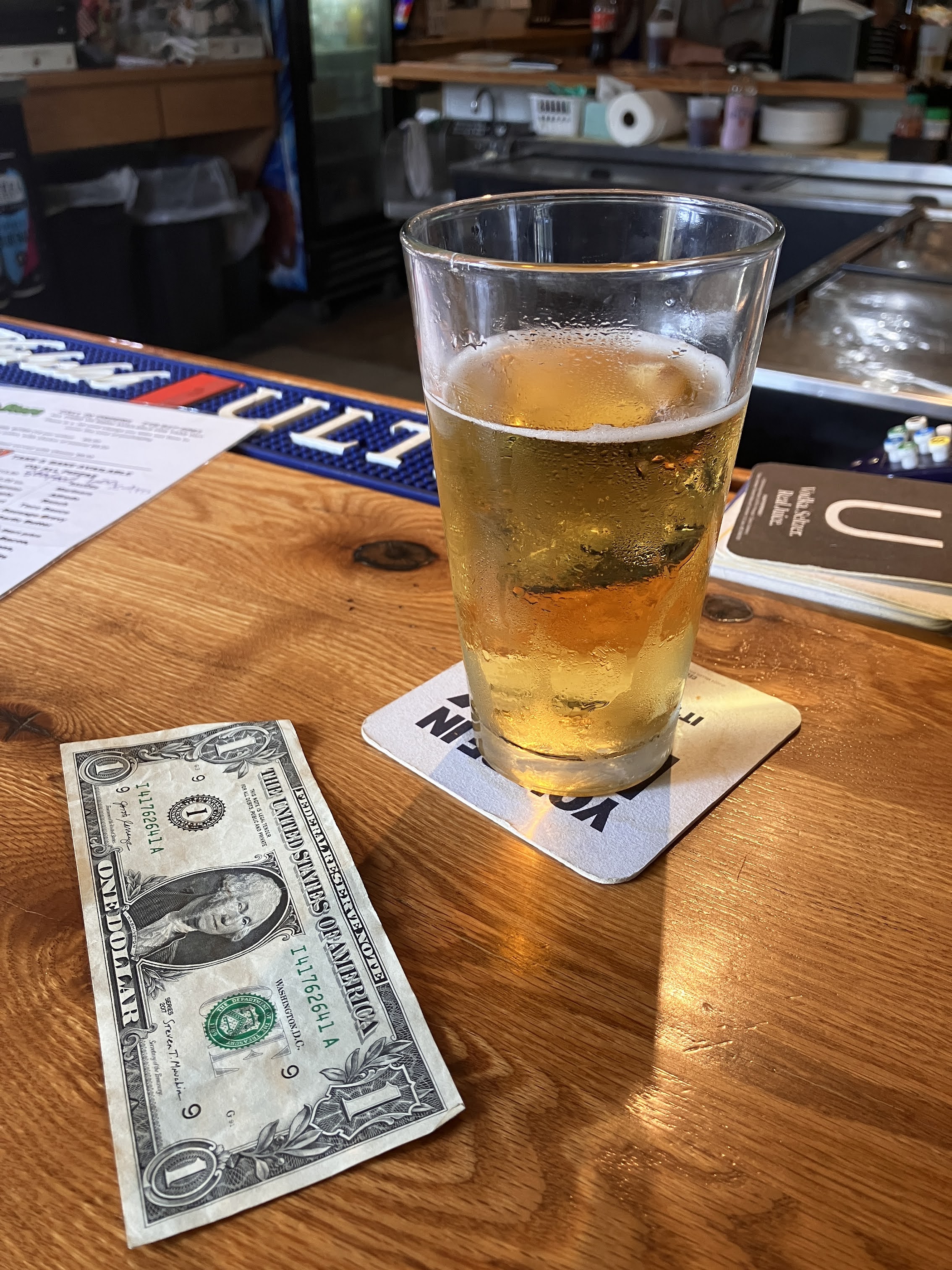
A $4 pint of beer at Long Pine Store.

By Michael Hooper

I’ve heard grumblings from people who are worried about a recession coming to the United States.

I know a portfolio manager who has been predicting a recession for two years now.


He says consumers have increased their debt levels at a time of higher interest rates. They no longer have Covid money from the government, and credit and car loan delinquencies are rising. Yet the recession has not happened.


Against all odds, the consumer is very resilient. 


Looking at government data and railroad reports, I can see there should be no discrepancy here, the economy is positively growing.


Real gross domestic product increased at an annual rate of 2.8% in the second quarter of 2024, according to the advance estimate released by the US Bureau of Economic Analysis. In the first quarter real GDP increased 1.4%. That was a reduction from the 3.4% growth in the fourth quarter of 2023.


The 2.8% increase in the second quarter 2024 in real GDP reflected increases in consumer spending, private inventory investment, and non-residential fixed investments, the government said. Imports, which are a subtraction in the calculation of GDP, increased. Consumers spent more in both services and goods. Within services, the leading contributors were healthcare, housing and utilities and recreation services. Within goods the leading contributors were motor vehicles and parts, recreational goods and vehicles, furnishings and durable household equipment, gasoline and other energy products.


Railroads in America have been hauling more freight in the first half of 2024, according to the Association of American Railroads. In the first 29 weeks of 2024 US railroads reported a combined US traffic of 13.5 million carloads and intermodel units, an increase of 2.2% compared to last year year.


It appears to me that a lot of traffic is coming from shipping containers and trailers, as intermodel units were up 8% while carload numbers were down 4%. These intermodel units carry lot of freight from China and around the world.


The Fed has been fighting inflation for the past two years. And they’ve been largely succeeding as inflation has dropped to around 3% from a high of 9%. The fed’s goal is 2% inflation yet the Fed has given indications it will start lowering interest rates soon; that has helped propel the stock market to all-time highs.


The S&P 500 is up 14.8% year to date; the Dow Jones industrial average is up 7.6% and the NASDAQ is up 16.3% YTD. About 25% of my portfolio is invested in the S&P 500.


The unemployment rate spent much of the last two years around 3%, but has moved up to 4.1% in the latest estimates from the Bureau of Labor Statistics. I’m not too worried about this increase because 4.1% unemployment is still a fairly healthy economy. This just means that employers will have more to choose from in their next hire.


Jobless people suffer, especially those who have multiple debts, including credit card and car payments, student loans and mortgage payments. Because interest rates are so high, a lot of home owners are refusing to sell their properties because their next home will likely carry a higher interest rate mortgage. People who have to move for a job face tough choices.


I had opportunities to leave Topeka but I turned them down because after moving three times in three years, I felt like I’d be losing by starting over somewhere else. The real estate agent who sold us our house stopped sending us annual flowers after about five years. She figured it out. We weren’t going anywhere.


It’s tough to say at this juncture who is going to win the presidential election, but in all likelihood, I think Donald Trump will be our next president. I hope not. I think the man is despicable, and I’m voting for Kamala Harris. She’s a solid woman who has demonstrated courage and tenacity as a prosecutor and has learned the ropes of what it takes to be a president by working as vice president for Joe Biden for the past three and half years.


We may see a dip in the stock market ahead of the election, as third quarters are often negative. People fear the unknown, sell stocks and put the proceeds in money markets. I think the stock market will likely recover in the fourth quarter after the election is over.


One thing for sure I will not be betting against America. Business cycles come and go. Bear markets and recessions happen. But overtime the US economy seems to pick itself up and move ahead. The U.S. economy is full of inventors, entrepreneurs and creative people who come up with new and innovative ways for people to spend money.


When Warren Buffett bought BNSF Railway in 2010 he said it was “an all-in wager on the economic future of the United States.” At the time the economy was recovering from the financial crisis of 2008-09. His bet on America proved to be a good one, as the economy grew substantially over the past 14 years. He paid $44 billion for BNSF Railway; the railroad is probably worth $145 billion today, based on the market cap of Union Pacific Railway, its chief competitor.  


Warren Buffett did not make his money shorting stocks. He studied losers, just to avoid them, but he made his money investing in winners. I think the US economy is a winner, so I’m betting on it.


Sunday, May 19, 2024

The Villages' History of Caring for Children

Hay bales at The Villages by Michael Hooper


By Michael Hooper, a volunteer on the board of directors.

The origin of The Villages dates back to the 1964. Dr. Karl Menninger founded the Villages after a judge told him there was a shortage of places where juvenile delinquents could stay.

He partnered with E. Kent Hayes, who had begun his career as the superintendent of the Boys Training School in Nebraska before moving south to Topeka. He would later serve as The Villages’ first executive director between 1967 and 1973.

Dr. Karl formed a nonprofit organization with a board of directors and trustees. He brought onto the board many of his friends in business, banking, medicine, academia, people who cared about helping troubled or abandoned children.

The first home opened in 1970, more homes were built in the early 1970s, for a total of five on 300 acres of land donated by W. Clement Stone. Dr. Karl believed children benefited from living close to nature. He believed kids should live in a family-style home, not an institution. People would refer children to the Villages and the state would cover the expense, although there was always shortages of money, so Dr. Karl was fundraising all the time.

The children went to school at Washburn Rural. 

Dr. Karl formed alliances with people in Lawrence Kansas, including Virginia Weaver and Hortense Oldfather, wife of local actor and KU theater professor Charley Oldfather. Hortense known as Tinsie, was on the board at the Villages for many years. The Oldfather father family donated land south of Lawrence, where two homes were constructed and began to house kids there.

The Villages hired an extensive staff to spread the word on the value of Dr. Karl's model helping troubled children.  The organization took its group home house parent model to other organizations around the country. Several homes were created in Indiana at one time, but are no longer part of the Villages. The house parent model included a full-time set of house parents who lived in the home with their own children, and who worked to care for the kids, took them to school, and basically were their parents. 

This model worked successfully for many years until about 10 years ago, during the Sam Brownback administration. The Villages started having really serious problems with this model. Many of the kids were extremely difficult, volatile, and even violent and dangerous. Worse yet, The Villages couldn't find anyone who wanted to be house parents.

Former executive director Sylvia Crawford was extremely good at management with limited resources, but still found herself short of staff. One time she and her husband actually moved into a house to become house parents because the previous house parents left, and we couldn't find replacements. One of the more aggressive children we had destroyed property causing over $6000 in damage. We did not have the psychiatric and clinical workers available to deal with such a difficult kids. Something had to change.

Sylvia found an opportunity to take care of immigrant children, unaccompanied children, from the border. These are children who left their homes and sought asylum in the United States. The Villages leadership applied for a grant to take care of unaccompanied children. We won that grant and began taking care of these immigrant children refugees seeking political asylum in 2017.

This caused our organization to grow. We used to have around a $3 million budget now our budget is closer to $7 million. We have about 100 employees. Currently we have about 35 unaccompanied minors living in Topeka. We plan to open the Lawrence homes to immigrant foster care children who will live with us a little longer than our typical kids. The federal foster care program for immigrant children will start around May 1 in Lawrence.

Most of our children are from Central America. As you may know, there is a lot of gangs and crime and political upheaval in Honduras, Guatemala, and El Salvador.

Our immigrant children are typically well behaved. They appreciate at the Villages. We take them to doctors and dentists to take care of their health. We have teachers on staff who teach them English, mathematics, science, geography. Our staff works to reunite the children with their parents, relative, or qualified sponsor. Candidates for placement are examined thoroughly and vetted to make sure the children will not end up in some kind of abusive situation.

Most the 400 acres owned by The Villages has never been plowed, it’s full of natural tall grass prairie. And there are two old Native American Indian burial sites on the land.

Rosemary Menninger, daughter of Dr. Karl Menninger, has been a volunteer board member for many years. She has been a tireless advocate for the children and the land.

About five years ago, we found ourselves running out of room, particularly in our administrative center, which was a split-level house. We were conducting school in the homes. We formed a building committee, with Judette Padilla, executive director, and started working with architects and consultants to come up with a plan. Ultimately Architect One was chosen as architect and KBS Construction as the builder.

The project would not have been possible without the generous help of multiple donors, including the Sunderland Foundation and many friends of The Villages, plus The Villages' endowment. The entire construction project cost around $7.2 million.