Thursday, January 18, 2024

Casey's Growth Playbook Works


By Michael Hooper

Stock in Casey’s General Stores (CASY) has returned 114% over the past five years, plus paid $7.09 in dividends during that time period.

Casey’s is poised for additional growth in 2024 with the acquisition of 22 Lone Star Stores in Texas that will be rebranded as Casey's stores

Casey’s is the No. 5 seller of pizza in America. Casey's breakfast pizza has grown in popularity.

At 22 times earnings, CASY stock is fully valued, but it almost always trades at this high multiple, with the stock trending up as EPS has grown over the years. The company deserves this 22 p/e ratio because of its growth rate. I see so much upside with the company's strategy that includes acquisitions and new builds. As a result I predict this stock may hit $310 per share. CASY closed Friday, Jan. 19, 2024, at $285.58.

As a boy, growing up in Iowa and Nebraska. I was familiar with Casey’s. The firm is based in Ankeny, Iowa.

Over the years. I have been impressed with how Casey’s has increased the quality and variety of its freshly baked foods. I saw the stock go up continuously over the years and thought I missed it. During the Covid crash of spring of 2020, all stocks corrected and I found myself with an opportunity to buy some of my favorite companies at a discount. I bought multiple stocks, including Casey’s at $130.25 per share on March 27, 2020. I have continued to add to my position since then, and recently added more CASY shares based on everything I see happening with this company, including strong margins for gasoline, high inside sales margins, vigilant cost containment and growth of its prepared foods business.

John Lawrence, analyst with Benchmark Company, issued a buy rating on the stock and gave it a price target of $312 per share.

Lawrence and other analysts met with Casey’s management recently at the ICR conference in Orlando. Management noted that fuel margins and profitability in the fuel business remain robust, as the last 10 quarters have yielded margins of over $0.35 cents per gallon and five of the last six quarters have been over $.40 per gallon. It appears this higher level of gas margin is sustainable overtime, Lawrence wrote.

In the third quarter, management said margins for prepared foods and dispense beverages was 59%, which is incredibly good. Total inside sales margin was 41.1%. Inside sales were about $1 billion in the third quarter, representing about 30% of total sales.

Lawrence said that over the last few years management has increased its new unit growth rate by making several acquisitions. He said the playbook calls for acquiring operators at a 6 to 9 times earnings range. CASY is then able to use its scale and food expertise to grow the high margin food component, which makes the acquisition profitable, he said.

The merchandise side of the operation continues to demonstrate solid growth in both the grocery and food service segments, he wrote.

Operating expenses continue to show improvement as same-store labor hours were cut by 2% last quarter, Lawrence wrote. Customers now have the loyalty club and the broader private label assortment to offer its customer base. The unique model that resides at Casey’s continues to yield higher levels of profitability. Management is using its scale to acquire operations, and then being disciplined on taking costs out of the business, Lawrence wrote.

"We continue to recommend purchase of CASY shares as management continues to execute the playbook," he wrote.

Lawrence said his $312 price target is based on 20 times fiscal year 2025 EPS estimate of $13.57 per share as the higher unit growth rate and consistent fuel margins in the mid 40s should enhance the multiple.

I live in Kansas, but travel to Nebraska often and stop at a Casey’s in Auburn, Neb. I usually buy fuel, go inside for a bathroom break and buy a doughnut or a water or a coffee or perhaps a juice drink. Maybe some popcorn. When my son was growing up, he always ordered the pizza. It’s not surprising. This pizza is a hit. The company recently added thin crust pizza.

Customers buy a lot of pizza and beer, the two go together, like Ebony and Ivory.

The company recently announced plans to hire a chief pizza and beer officer.

Casey’s has a history of serving smaller towns in the Midwest, they can make a business go with a population as little as 300. They have some stores where it's the general store for the whole town; for basic groceries like milk and juice, eggs, bread, and coffee. And if you’re a member of Casey’s rewards program you get a discount.

Casey's has entered several mid-tier markets and is doing quite well. The company's new store in North Topeka is going gangbusters. Casey's is building a new store near Highland Park High School in Topeka. I imagine those high school students will buy its pizza.

A relative of mine has noticed many kids buying the breakfast pizza at the Casey's in Geneva, Neb., before they go to the high school there.

Casey's market cap is around $10.5 billion. Company has $409.89 million in cash and $1.65 billion debt.

The company said it operates over 2,600 convenient stores. Founded more than 50 years ago, the company has grown to become the third-largest convenience store retailer and the fifth-largest pizza chain in the United States. The company says Casey’s provides freshly prepared foods, fuel and friendly service at its locations. Guests can enjoy pizza, donuts, other assorted bakery items, and a wide selection of beverages and snacks.

The company said approximately 50% of Casey's stores are still found in areas with populations of 5,000 or less. In contrast, roughly 25% of Casey's are now located in areas with populations of 20,000 or more. Casey's has a strong balance sheet and owns nearly all of its assets, which allows the company to consistently take advantage of growth opportunities.

Conclusion

CASY stock is a keeper. I recommend buying this stock and holding it for the next three to five years as Casey's continues to implement its playbook.

Monday, November 20, 2023

Topeka Native Brad Garlinghouse Cleared of Wrongdoing in Crypto Currency Lawsuit

Brad Garlinghouse

By Michael Hooper

In the world of cryptocurrency it’s sometimes hard for the government to tell the difference between the good guys and the bad guys. 

While the government let Sam Bankman-Fried go unchecked in the Bahamas, squandering billions of dollars in crypto at FTX, the U.S. government was actively trying to take down Ripple Labs and its CEO Brad Garlinghouse and cofounder, Chris Larsen.

In the end, the courts found Bankman-Fried guilty and he faces the potential for over 100 years in prison, and the Securities and Exchange Commission decided to drop its lawsuit against Brad Garlinghouse, Chris Larsen and Ripple Labs.

Garlinghouse is the son of Kent and Susan Garlinghouse of Topeka, he is a graduate of Topeka High School, the University of Kansas and Harvard Business School.

More than four years ago the SEC filed a lawsuit against Garlinghouse, Larsen and Ripple Labs alleging that its cryptocurrency, XRP, is a security and should be registered with the SEC as such. But last July a judge ruled that XRP is not a security. Then in October the SEC dropped its lawsuit against them with prejudice.

“I think this is a huge win, not just for Ripple but for the whole industry,” Garlinghouse told CNBC after the judge’s ruling in July.

Ripple has spent about $200 million defending itself against the SEC. Wow, that’s a staggering amount of money. 

I have to admire Garlinghouse for never giving up, never throwing in the towel, it’s hard to fight the government. It cost a lot of money, but in the end, Garlinghouse and his colleagues at Ripple Labs won. In a sense they helped usher in a new era in regulation of cryptocurrency. In the future, the SEC will think twice about filing lawsuits against the creators and founders of a cryptocurrency.

A key difference between a security and a crypto currency is ownership. With a security, you presumably own a share of a company. With crypto, you don't own a piece of a company, XRP does not give you a share of Ripple Labs.

The price of XRP was trending around $.45-$.50 before the judge's ruling in July. After the ruling XRP jumped to $.70 and then fell back down around $.50 and now it’s around $.62 per unit.

Ripple Labs uses XRP as a way to perform cross border transfers of money around the world. For example, if someone wanted to send $5,000 from the United States to a friend in Dubai, they could buy $5,000 worth of XRP, ship the crypto to the friend, then the friend could sell the XRP on the open market and take proceeds in the currency of his choice.


Wednesday, November 15, 2023

Attachment Styles, Trauma & Transcending Pain

Moon watercolor by Michael Hooper

By Michael Hooper

In Widen the Window, Elizabeth Stanley says early life experiences, especially with our parents and other important caregivers, powerfully reverberate throughout our lives, especially in how we interact with other people and cope with and recover from stress.

In Chapter 6, the author says attachment styles are developed based on our relationships with our parents and primary caregivers from childhood.


She says empirical studies suggests that about 3/4 of adults keep the same attachment style throughout their lives.


Attachment styles


She describes attachment styles as communication patterns, and relational strategies which get encoded in our brains as implicit and procedural memory. Our attachment style affects how much physical closeness and contact we have with others, our social engagement with other people and groups. She defines four attachment styles.


There are avoidant adults who tend to operate with a narrow window, who cope by avoiding contact. Their mother tended to dislike contact with her babies.


Insecure, anxious child gets this way through a mother, who interacts with them unpredictably and inconsistently responding to her own emotional needs and moods first not her babies needs


Anxiously attached adults tend to prefer intense and enmeshed relationships. They tend to find isolation stressful, and they fear abandonment and seek excessive reassurance.


Infants will develop an insecure disorganized style of attachment when their parents are some combination of neglectful, abusive, depressed, or traumatized themselves.


The predominant disorganized relational strategy is, “I need contact but I can’t let my guard down.” 


Childhood adversity


In Chapter 7, the author says a man she dated when she served in the Army called her a trauma magnet. This makes me wonder why she attracts so much hardship and pain?


She says individuals who experience trauma and adversity in childhood often endure additional traumatic events later in their lives. It appears certain people develop lifelong patterns of trauma and despair.


In her chapter on childhood adversity she says empirical research shows that early life chronic stress leads to structural changes in the developing brain. Children with early life, chronic stress, are likely to develop larger and hyperactive amygdala the survival brain region, and they are more likely to develop a smaller, prefrontal cortex, the thinking brain region.


There are clear, neurobiological reasons why someone from a "challenging" upbringing is more likely to have difficulty making good decisions, controlling impulses, regulating emotions, developing supportive relationships, and recovering from stress. 


Stanley says we can rewire our thinking, we can experiment with new internal and external tools to access a wider range of adaptive responses during stress. We can learn to interrupt the survival brains, default programming, and the coping habits we adopted in childhood. 


The author, Yiyun Li recently wrote in the New Yorker about feeling anguish over the suicide of his son Vincent at age 16. He says anguish comes to us from the Latin, Angustia means narrowness, lack of space, narrow passage, limitations, confinement, imprisonment, and pettiness. 


Can we say narrow window, Stanley's go-to metaphor!


I have a friend of mine, who is a fellow artist. He’s very talented, but he’s always in a state of self analysis, he says his life is meaningless and worthless. He’s always making these statements on FB about his insecurities. I call them fishing expeditions, to lure someone in who is going to provide him assurance that his life is OK and worth living, that he is a talented artist and so forth. I fell for this trap a few times, but I gave up…..I tried to help him but he goes back to self loathing. It’s like he’s on a loop.


In the song, Candy Says, by the Velvet Underground, she sings, “Maybe when I'm older, what do you think I'd see If I could walk away from me?"


If you figure out how to rise above self loathing; get off the loop, and it seems the world opens up to you.


To me, the wise soul has acquired the tools to handle everything that hits him in his window, he has the ability to transcend, all of these limitations and restrictions and confinements by using the power of the mind to concentrate on going in a new direction.


I recently read a book by Chloe Cooper Jones, I met her at the Kansas Book Festival, she wrote a book, called Easy Beauty, and in there she talks about how her generation of people are so self-absorbed, and that we need to go through a period of un-selfing in order to get away from all this self absorption.


I like to transcend all of this self-absorption by studying the world of ideas, and how these ideas might be used to change or improve society. I like to study art and ask myself how can I paint a better picture. How does a musician capture the purity of a song? 


Lately my wife Heather and I have been singing along to old songs by the Carpenters, is there a more sweeter sounding voice than Karen Carpenter?


In church, my friends Mike Cox and Gordon Haight and I sing together. My voice is not that great, but together with these men, we sound like Crosby Stills and Nash and Young.


David Bowie says you can be a hero for just one day.


One day, Heather and I took our two children and a foreign exchange student Momo Yamaguchi of Japan to a Native American drum event near Holton. We listened to these elders pounding the drum and chanting and singing and howling. We heard the awakening of their souls, the sound of sorrows. A sublime dimension.


The tiny window that I created around my anguish seems to have disappeared and now I’m looking for ways to connect with music, and art, poetry, laughter and love, a highway to transcendence.


I would say, my attachment style is moderately outgoing, with a curiosity about people, and a willingness to share a friendly smile, and a kind word, to perhaps, engage with a soul. I like working by myself but I enjoy the camaraderie of working with others toward a larger goal.


I remember, Jude Highberger, who used to attend meetings with this group. He and I had a discussion about attachment styles.


He said, “I carry every one I ever met with me.”


Wow, What an example for us to follow.


Shock trauma


In chapter 8, she says shock trauma is in another way for the Window to narrow. Shock trauma is when the body feels an acute or unexpected event that has a major effect on the mind-body system. During shock trauma we experience too much stress, and emotional intensity, thereby overwhelming our window of tolerance. These events could be like a hurricane, or a tornado or a fire or a divorce or a childhood death or something major. She suggests that we should take some time to make a list of experiences of shock trauma throughout our life. Write down all these shocking and earth-shattering events that tore up your heart. Once the list is complete take some time to think about it evaluate what happened and perhaps what could you have done differently and how we might act today. 


Reviewing my shock traumas right now probably will do more harm than good for me. 

Is it wise to go down the road of reviewing shock traumas without the aid of a therapist?

Elizabeth Stanley is trying to be scientist and therapist in her book. I'm not sure she is succeeding at either endeavor. She is at the center of all these issues because she has been through these trauma events, with real-life combat experience, which seems to deepen the depressive nature of the content of this book.


At the end of chapter 6, the author encourages you to reflect in writing about your own attachment styles both as a child, and as an adult, and that as a part of this exercise, you should speak with your parents, your siblings, or other people who knew you as an infant and a child. Is this really appropriate? Is there any lasting value in this technique?


Wednesday, September 27, 2023

Time Is No Friend

Peabody Park, Appleton, Wisconsin, watercolor on paper by Michael Hooper

Time is no friend, she does not console, she offers no pathos,

she is a machine, accurately ticking away the days,

she will take you to your grave,

yet she is our most valuable resource, more valuable than gold,

we must love her and cherish her, and be devoted to her;

she is the mistress that will not love us back, yet leaves us wanting more.

Time travels at top speed in the years, but like a turtle in the minutes and hours of the day.

Moments are preserved as time-stopping pictures, for memory, for edification, for hope, for desire, for nostalgia, for beauty, for sadness, despair and eternal life.

-Michael Hooper, 9.27.2023


Wednesday, August 9, 2023

Thunder in the Soul


By Michael Hooper

In Chapter 6 of Thunder in the Soul, author Abraham Joshua Heschel laments about the demise of the spirit in mankind. In our quest to conquer space, we have forfeited our spiritual connection to the divine. In our quest for order, we renovate our spaces, we buy stuff at Home Depot, we upgrade the kitchen, we have fixed up our home, but we have left our soul empty.

We have gained power over space, but we have lost an appreciation for quiet time with God. Heschel, the rabbi, says there is a realm of time where the goal is not to have, but to be, not to own, but to give, not to control, but to share, not to subdue, but to be in accord.

As civilization advances, the sense of wonder almost necessarily declines. Heschel says mankind will not perish for want of information, but only for want of appreciation. The beginning of our happiness lives in the understanding that life without wonder is not worth living. What we lack is not a will to believe, but a will to wonder. 

I wrote a book called the Wonderment Years. I think I was trying to capture that sense of wonder and awe at God’s creation, my love of Yellowstone Park, European travel and the serendipity of finding camaraderie and friendship in the world. My book was an attempt to thank God for my wife and my children while capturing my sense of awe for nature. Yet I am a modern man who is wired for desire to gain wealth, to prove that I am just as good or better than anyone on Wall Street, I have a competitive spirit, I want to win, but win what? More wealth, more pleasure, more things, a new kitchen in the cabin, a new E bike? 

Heschel writes that the modern man has supreme faith in statistics and abhors the idea of mystery. Modern man can explain away all mystery; he considers religious knowledge as the lowest form of knowledge. Modern man marvels at the databases of Google and Amazon, where he can look up any information or buy anything in the world. If you are a materialistic person, you may find yourself with an overstuffed house, garage, and storage unit. 

The modern man has ceased to trust his will to believe, or even his grief about the loss of a desire to believe. Indeed, we are in greater need of proof, for the authenticity of faith than of proof, for the existence of God. How have we lost our faith? Through our wealth and desire for order, we think we can buy and sell anything including our health. We spent our youth gaining our wealth, and now we are spending our wealth to regain our youth. Our wealth is seen as our protector, our fortress, our defense. Our power. Heschel says if the world is only power to us, and we are all absorbed in a gold rush, then the only God we may come upon, is the golden calf. 

What are the symptoms and behaviors of this person who no longer is in connection with God. He has lost his awareness of the grandeur and the sublime. He no longer has a sense of awe for God. 

Heschel writes, We teach the children how to measure, how to weigh, but we fail to teach them how to revere, how to sense wonder and awe. The sense for the sublime, the sign of greatness of the human soul. Yet the world has become an oyster plate, and the soul has become a vacuum. The empty soul as vacuum sucks in Images from Instagram, information from Google, scans all the latest technology gadgets on the Best Buy website, but the sucking noise from the vacuum is just a shrill emptiness, his soul is crying for meaning and purpose, there is thunder in his soul. 

Have you ever been in a conversation when your companion stops looking at you and picks up his phone and checks his social media status? This behavior is called Pfubbing or phone snubbing. It is the act of ignoring a companion to use a smart phone.

There is a third party between you and your companion, and the result is a lack of intimacy or real bonding.

Modern man is overly obsessed with the physical phenomena of the world. He is not concerned with the ultimate question of the Bible. What does God demand of us?

To answer that question we need a personal relationship with God. The answer, in part, will probably include developing a deeper love for oneself, and a deeper love and respect for those around us.

The fulfilled soul is generating peace in connection with God and nature. The fulfilled soul smiles from within and shares, generosity, and love. The fulfilled soul can sit in silence and be at peace, the figety soul is constantly creating or producing order in the shop, fixing a roof or structure, repairing the car, taking the car to the car wash. The fulfilled soul is at peace with his oneness with God, and is no longer restless. There is chaos in the world, there is suffering all around, yet the dude abides. His soul is full.


Saturday, June 24, 2023

Into The Mystic Flint Hills

Mission Valley Ranch, oil on canvas, 10" x 14"


By Michael Hooper

Joy, reverence, gratefulness and awe were some of the feelings I experienced while painting at Mission Valley Ranch, near Alma, Kansas. This experience on Father’s Day was meaningful for me because I had been dreaming of painting in the Flint Hills for years. 


In my early days as a business reporter, I had written a story about Bill Hogue, a homebuilder and rancher, who owns the Mission Valley Ranch with his wife, Kathy. I had visited their ranch near Dover, but had never been to their ranch near Alma so this was a treat. The trip was arranged by Ye Wang, art professor at Washburn University.


Entering the ranch, I was thunderstruck by the huge vista over this land, we drove down into a valley, where I saw a house and two tiny cabins made of stone. Lots of Kansas limestone in these structures.


I listened to the wind, and the sound of leaves blowing, occasionally a cow mooing. Nature is so loud it’s like an orchestra if you listen to it.


Ye Wang set up his painting station on a road under trees near a creek. I wanted to be closer to the prairie with a view of the Flint Hills. My wife, Heather and I drove farther into the ranch, and then I set up next to an alfalfa field that was surrounded by rolling hills and trees. As I set up my painting station, several cows walked near me. It had rained the night before, but now the clouds were thinning out, and I felt the warmth of the sun.


Connected to nature, yes, that is the awakening point in my soul. I laid out a composition pretty quickly and started painting, feeling a sense of the forms and their values.  I filled my canvas with deep greens in the forest, the light yellow green on the hillside, and the gray blue sky coming through the clouds, the intricate blue green alfalfa with a few weeds thrown in, including some ditch weed, all part of my painting. The grass on the road fell to a golden touch. My wife took a nap.


Reading the words of Abraham Joshua Heschel, I am contemplating his notion that we need to approach God with a sense of awe and wonder in order to connect with Him. It is not hard for me to approach God with a sense of awe because he created the universe and the stars and the Earth and this majestic land. His universe is still being created. His artistry is in full scale production, on Earth and in the far-reaches of the universe, where new stars are born. But most people would not be contemplating this idea — God as artist — because they have their heads buried into their phone, watching reels on Instagram.


“As civilization advances, the sense of wonder almost necessarily declines,” wrote Abraham Joshua Heschel, in Thunder in the Soul. “Such decline is an alarming symptom of our state of mind. Mankind will not perish for want of information, but only for want of appreciation. The beginning of our happiness lies in the understanding of life without wonder is not worth living. What we lack is not a will to believe but a will to wonder.”


Nature exhibits this sense of wonder and curiosity. A hummingbird flew toward me, hovered and checked me out. We locked eyes and then he flew back into a tree. Insects continue to fly into my space, I’m afraid they are doomed if they get into my paint. I shoo them away.


Heather and I enjoyed a picnic with cold fried chicken, grapes and chips. My painting was nearly finished. We went for a walk along the ranch road, the alfalfa field on our left and a hillside with trees at our right. Multiple paintings could be had in this moving landscape. 


On the way out, we stopped to look at Ye Wang’s painting. This man is brilliant with brush and paint. He chooses the best compositions; his painting of the road and creek under the trees is magical. Heather took our picture together.


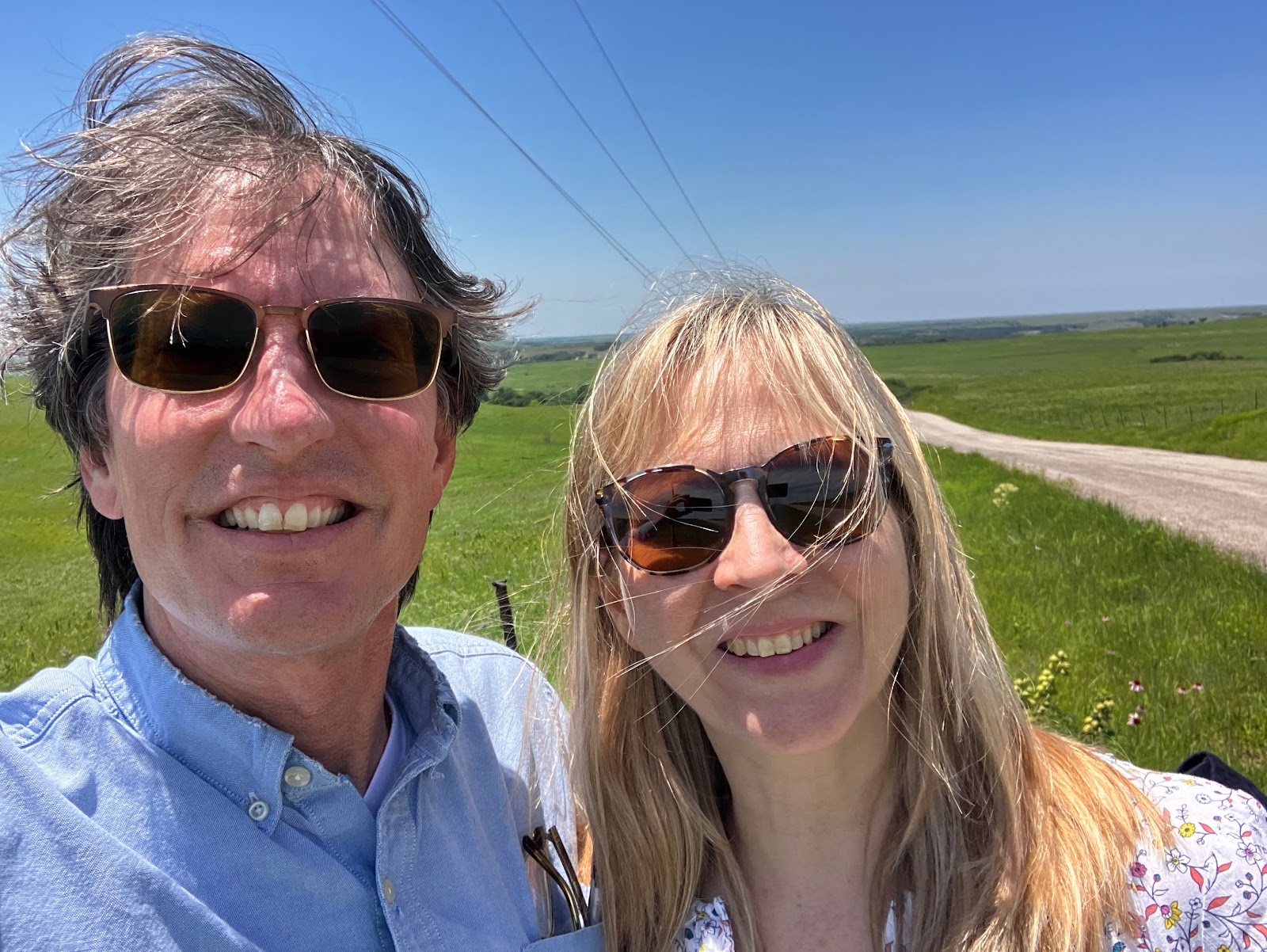
Heather and I drove through the hills and took a selfie at the top of a hill southeast of Alma. I am immensely grateful to Bill and Kathy Hogue for letting us visit their ranch. And thank you Ye Wang for arranging this special day.


That night, I slept with superior contentment. In the morning, I felt a rapturous thrill waking up and thinking, how lucky for me, I get to enjoy another day. With a cup of coffee in hand, I walked through my garden into my shed/art studio, where I touched up my landscape painting. 

I look at my composition, it takes me back to the subject. It's a reminder of that wondrous mystical encounter in the Flint Hills.